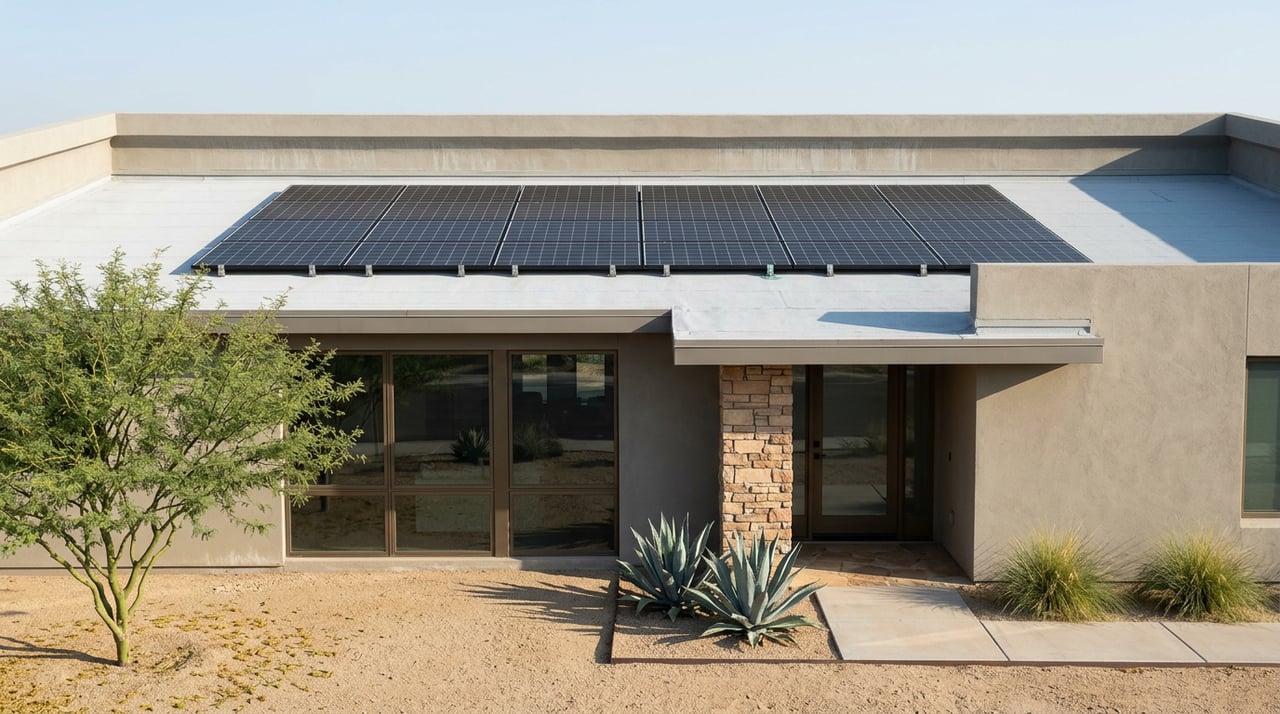
Why Leased Solar Panels Can Quietly Stall a Henderson Home Sale
September 3, 2026
September 3, 2026
Scroll through active Henderson listings right now and you will find the same amenity line again and again: solar panels (lease). It sits next to granite counters and a covered patio like any other selling point. For a house in Cadence or Inspirada, it often is a selling point. Lower utility bills, a system already in place, one less thing for a buyer to think about.
Except a leased solar system is not like a granite counter. It is a financing agreement that follows the house, and it runs on a clock that has nothing to do with your escrow timeline. If you own a home in Henderson with a leased or third-party-owned system and you plan to sell, the panels themselves are not the problem. The paperwork behind them is, and it moves at its own pace whether you are ready or not.
When a solar company installs a system under a lease or a power purchase agreement, it still owns the equipment. Solar Equity Solutions says the company typically files a UCC-1 financing statement against your property to protect that ownership interest, the same kind of filing a lender uses to secure a loan against collateral. That filing shows up during a title search. If it is not released or formally transferred, it can hold up closing entirely, regardless of how strong your buyer's offer is.
This is different from a mortgage payoff, which your title company handles as a routine part of every closing. A solar UCC-1 has its own release process, and it depends on the solar company's own transfer department, not your lender and not your title officer.
Here is where Henderson sellers get caught off guard. A standard Nevada purchase agreement gives buyers a due diligence period. Most sellers think of that window as being about the inspection report. It is also the window during which a buyer discovers the solar lease, and by the time they do, the clock on transferring that lease may barely have started.
| Process | Typical timeline |
|---|---|
| Solar lease credit approval and transfer | 2 to 4 weeks |
| UCC-1 release after buyout | Days to a few weeks, depending on the provider |
The buyer's mortgage underwriting and the solar company's credit approval happen on separate tracks, run by separate companies, with separate underwriting standards. Most solar providers require a credit score somewhere in the 680 to 720 range for a buyer to assume an existing lease, a threshold that has nothing to do with whether that same buyer already qualified for their home loan. If you list a Henderson home with a leased system and your buyer's due diligence period closes before the solar company finishes its own approval, you are negotiating an extension on a deal that already has a signed contract, not planning ahead of one.
A Nevada real estate broker named Spencer Walden ran into a version of this that took a full year to resolve. A property he had listed found a buyer, but the buyer was purchasing through an LLC, and the solar company refused to transfer the lease to a business entity at all. Walden's seller had to let that buyer walk and find an individual purchaser willing to take on the assumption before the sale could close.
That distinction matters more in Henderson than in a lot of markets, because investor purchases through LLCs are common in a valley where out-of-state buyers frequently buy through entities for liability and tax reasons. If your buyer pool includes investors, a leased solar system can quietly shrink that pool before you ever see an offer.
Not every Henderson listing carries this exposure equally. Green Valley, Inspirada, Seven Hills, Anthem, Cadence, and Whitney Ranch all show up repeatedly among the city's most active solar listings, but they don't all carry the same kind of solar. New construction in Henderson concentrates in Cadence and Inspirada, while Green Valley and Anthem represent longer-established resale stock, and that construction timeline matters here. A recently built Beazer Homes section of Cadence, for example, markets its homes as "Zero Energy Ready" with the solar system included as owned equipment, not leased, which changes the calculus entirely, since an owned system transfers with the house the same way a roof or a water heater does.
Before you assume your home falls into either category, pull the original solar paperwork and check whether you are dealing with a lease, a PPA, or a system you financed and now own outright. The three look identical on the roof and behave completely differently at closing.
According to 2025 data from SolarReviews, homes with owned solar sell for an average of 6.9 percent more than comparable homes.
Nevada's net-metering program adds another wrinkle worth knowing before you price a listing around solar. Henderson homeowners fall under NV Energy's Tier 4 net-metering program, which credits excess production at 75 percent of the retail electricity rate and locks that rate for 20 years from approval. Starting in April 2026, NV Energy also began applying a daily demand-style charge to residential bills, meaning even a strong solar producer still receives a monthly bill rather than a zeroed-out one. Whoever ends up owning the system, whether that is you at buyout or your buyer at assumption, is stepping into that rate structure, not the one that existed when the panels went up.
Nevada gives solar owners real, if narrow, protections that are worth knowing on both sides of a transaction. Assembly Bill 405, sometimes called the Renewable Energy Bill of Rights, sets baseline requirements for how solar leases and purchase agreements must disclose payment terms, installation timelines, and warranties. Separately, Nevada Revised Statutes 361.079 exempts the added value of a residential solar system from property tax assessment, so an owned system that raises your home's value does not raise your tax bill along with it. Neither statute removes the transfer friction described above. Both are worth having in hand if a buyer's agent or a title company raises questions mid-escrow.
Doing this before you list, rather than after you accept an offer, is the difference between a solar system that helps sell your Henderson home and one that quietly extends your escrow by a month.
Can I sell a Henderson home with a leased solar system at all? Yes. Most solar leases transfer through a straightforward credit approval process. The complications above are about timing and buyer eligibility, not about whether a sale is possible.
Does an owned system add more value in Henderson specifically than elsewhere? Henderson does not have unique data separate from the broader Nevada market on this point, but the same principle applies here that applies statewide: owned systems generally sell for more than leased ones, and Nevada's property tax exemption under NRS 361.079 means that added value will not increase your tax bill.
If you are weighing a Henderson listing and you are not sure whether your solar system is a lease, a PPA, or something you already own outright, that is exactly the kind of question worth answering before a buyer's lender asks it for you. Emma-Lee Samaniego has walked Henderson sellers through this exact paperwork before listing goes live. Let's Connect.
This article is general information, not legal, tax or financial advice. Consult a qualified professional about your situation.
Stay up to date on the latest real estate trends.

Every client deserves personalized attention and reliable guidance. Work with a real estate professional dedicated to helping you achieve your goals. Whether you're exploring the community or planning your next move, I am here to help you learn more about everything Nevada and Arizona has to offer.